Mastodons
A Journey to the Centre of the EarthThe Mastodons are a herd of living prehistoric animals encountered by Henry and Professor Hardwigg in the underground world. Their appearance turns the expedition’s geological record into immediate experience: creatures previously known through fossil remains move, feed, and uproot trees before the explorers, while a giant human figure appears to guide them. The encounter unsettles the boundary between extinct past and living present, and makes the underground landscape not merely a record of ancient life but a habitat occupied by beings beyond human control.
From Fossil Record to Living Animals
The encounter follows a journey through strata that Henry reads as a progression through geological time. In the Silurian rocks, he identifies an early stage of formation; later, the marbles bear traces of animal life more advanced than the trilobites they had seen before. He recognizes remains of fish associated with the Devonian seas and understands the fossils as signs of life moving upward through geological history. The layers are not abstract scenery: they teach the explorers to read the ground as a succession of former worlds.
That scientific sequence is unsettled when the explorers reach a forest where vegetation from distant regions grows together, including oak, palm, eucalyptus, Norwegian pine, and New Zealand kauri. Against this disorienting mixture, Henry sees enormous animals moving among the trees. They are not fossil bones or shapes preserved in stone, but a living herd of Mastodons. The passage from strata to forest thus turns geological time into a direct encounter: what had been evidence of vanished life is now animate and near.
The Herd in the Forest
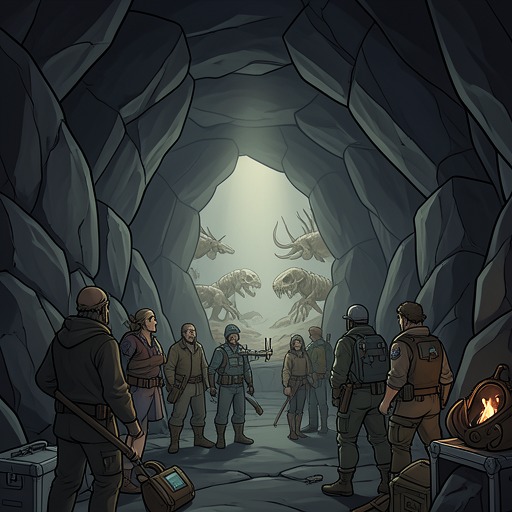
Henry first sees the animals at a distance through the unusually diffuse light, then makes out their scale and activity. Their trunks tear down large branches and work among the trees; their tusks uproot trees, while the boughs crack and leafy masses disappear into their capacious mouths. The scene gives the herd a material presence through its effects on the forest. Its feeding is not a static tableau for scientific inspection: trees fall, branches break, and the animals consume the vegetation around them.
The explorers’ response combines wonder with alarm. Henry recognizes the scene as a realization of prehistoric ages brought back to life, but the realization does not make the animals familiar or safe. He and his companions are alone deep beneath the Earth and at the mercy of its formidable inhabitants. The herd’s independent movement and feeding establish it as more than a fossil curiosity: it occupies and alters its environment, while the human observers have no command over it.
The Human Figure and the Encounter’s Stakes
Professor Hardwigg then draws Henry’s attention to what appears to be a human being among the animals. At a distance of no more than a quarter of a mile, a figure leans against the trunk of an enormous tree. The apparent keeper is described as a giant, more than twelve feet tall, with a buffalo-sized head and a mane of matted hair. The narrative associates him with guiding and driving the Mastodons, making the encounter stranger still: the herd appears to belong to an underground order of life in which a humanlike being can stand among such immense creatures.
The discovery moves Henry from skepticism to reluctant acceptance of what his eyes show him. The living Mastodons and the giant figure are sharply contrasted with the human skull the explorers had encountered earlier in the great fossil cemetery. That skull had seemed to bring a Quaternary human being face to face with the travelers, but it remained a preserved relic. The animals, by contrast, are alive and active; their presence makes the ancient world neither safely buried nor wholly past.
Scientific Time and the Limits of Classification
The episode draws force from the expedition’s earlier scientific disputes. Professor Hardwigg insists that observed facts can overrule theories, and a thermometer reading of 27.6 degrees challenges an expected rise in temperature with depth. The travelers also know the controversy surrounding the Moulin-Quignon jawbone: claims for human antiquity had been debated, and discoveries of remains and apparently worked fossil bones had pushed human history further back in time. Against that background, living Mastodons are not simply another item to classify. They confront the explorers with a world in which geological periods and familiar distinctions between fossil and living life no longer provide secure limits.
The herd’s narrative significance lies in this reversal of perspective. The explorers have treated strata and fossils as evidence from which the history of life can be reconstructed; now that history stands before them in enormous, feeding bodies. The Mastodons remain animals in their own right, not merely specimens, because their actions fill the forest and place the human travelers at risk. Their appearance makes deep time immediate, embodied, and uncontrollable.